
One Street Address, a District-Wide Invitation
An in-person congressional town hall has one venue address. The constituents invited begin their journeys across the district, with different transportation options, schedules, and access needs. Choosing a room settles only part of the planning.
I would begin with a linked planning file: a district coverage map, a travel comparison, a dated venue walkthrough, an invitation log, and a post-event review. Together, those records show how organizers made participation possible and where arrangements need attention.
This approach puts operational decisions ahead of crowd size. A district-wide invitation can break down at the return bus connection, locked entrance, check-in queue, or question microphone even while seats remain empty.
The process described here is a proposed framework, not a record of forums held or turnout achieved by Jan McDowell’s campaign. Keep organizer identity explicit throughout: a campaign-organized forum is distinct from an official congressional constituent event.
Map the District Before Building the Invitation List
Confirm the congressional boundary applicable to the election before compiling outreach areas. City and county outlines provide useful reference points, but they do not define the congressional audience. A familiar municipal venue can still be inconvenient for residents elsewhere in the district.
Build the coverage map around decisions the team must make:
- Congressional boundary: establish invitation coverage.
- Residential population patterns: select starting areas for travel tests.
- Roads and transit: identify connections and compare routes.
- Community gathering places: identify potential venues and notice locations.
Where reliable aggregate information exists, add age distribution, languages spoken, disability-related access needs, vehicle availability, and household internet access. Connect each layer to an action, such as language assistance planning, seating arrangements, printed notices, or a non-digital response route.
Record each dataset’s publisher, release date, reference period, geographic unit, and relationship to the selected boundary. Preserve the full reference period of a five-year estimate; older estimates may describe current neighborhoods imperfectly. Mark census areas that cross district lines rather than treating their entire population as district residents.
That discipline keeps planning for North Texas communities grounded in documented geography.
Compare Travel Burdens, Not Just the Center of the Map
A geographically central venue, a venue near established transportation routes, and rotating neighborhood forums deserve separate tests. The map’s center offers a convenient starting point. Route comparisons show whether that convenience extends to residents.
Use the Same Arrival Window
Select representative starting areas before testing venues. Use the same routing method and arrival window, with driving and transit recorded separately. For an illustrative 6:30–7:30 p.m. forum, test arrival between 6:00 and 6:20 p.m. and return departures between 7:30 and 8:00 p.m. These are planning conditions, not an announced event schedule.
Record the origin area, destination entrance, mode, routing date, intended arrival, transfers, parking assumptions, and final walking segment. Check the relevant weekday’s transit timetable, including what happens if someone misses a connection after the discussion.
A short straight-line distance can conceal a difficult trip when road connections, transfers, or pedestrian routes are poor. Routing estimates also remain tied to their tested assumptions; they cannot promise an individual journey time.
Rotating forums require the same scrutiny at every proposed address and date. More locations alone do not establish better access.
Inspect the Route From Parking Space to Microphone
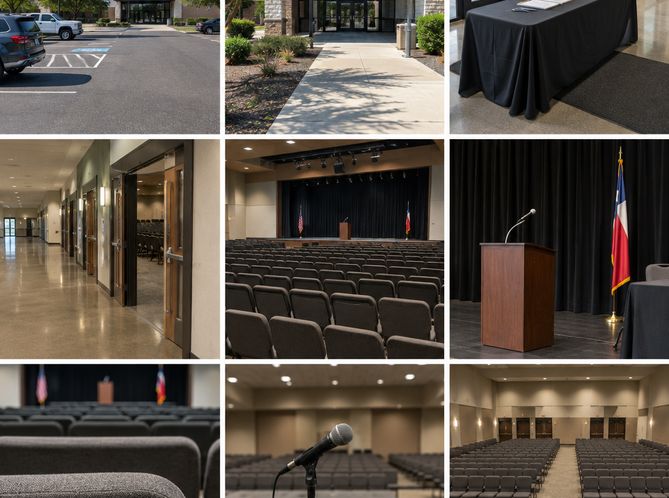
Assign a venue-access lead to walk the complete visit: arrival, entrance, check-in, seating, hearing the discussion, asking a question, and departure. Use the proposed room layout during the inspection.
| Criterion | Verification Method | Scheduling Consequence |
|---|---|---|
| Arrival and entrance | Follow the step-free route; check doors and unlocking arrangements. | Confirm the usable entrance before publishing directions. |
| Restrooms and seating | Inspect restroom access, aisles, and mobility-device spaces. | Set attendee seating from the proposed layout. |
| Sound and lighting | Test speech from the rear and sides; inspect lighting. | Resolve equipment needs before confirming the room. |
| Connectivity and setup | Check planned connections and setup access. | Allow time for equipment preparation. |
| Weather arrangements | Review arrival exposure and disruption plans. | Assign the contingency decision owner. |
This checklist supports operational review; it does not certify legal compliance. Record actual findings after inspection rather than assigning unsupported scores.
Obtain approved occupancy information, then draw seating, circulation space, check-in, and equipment positions. Advertised capacity cannot substitute for usable attendee seating. Establish a question-submission option for someone unable to approach the microphone.
Track Invitations Without Inflating Who Was Reached
Build invitations from verified access information. Every version should identify the organizer, address, entrance, date, start and end times, participation format, accommodation contact, and any genuine registration requirement.
Keep outreach activity, delivery, responses, registrations, and attendance separate. Sending an email records an organizer’s action. It does not establish that a resident saw or understood the invitation.
Match Each Channel to Its Access Barriers
- Email: consider internet access and distinguish sending from delivery failures or replies.
- Printed notices: consider whether residents visit the placement location and can use the stated response route.
- Community calendars: distinguish a submitted listing from confirmed publication.
- Public social posts: consider platform access and keep recorded views separate from identifiable residents.
The outreach log should capture channel, date, intended neighborhood coverage, language, response route, responsible role, delivery evidence, and invitation version. Do not combine recipients, copies, listings, and views into a unique-resident total when overlap is unresolved.
Permission to rent a room or display a notice also does not establish a community partnership. Describe the documented arrangement precisely, including in press & public commentary.
Read Attendance Patterns Without Calling Them District Opinion
Attendance records can reveal arrival pressure, room use, participation routes, recurring logistical questions, and reported access problems. Voluntary attendance does not establish district-wide opinion about Texas priorities.
Define the counting method before doors open. Specify who counts, how repeat entries are handled, and whether staff and volunteers appear separately. Keep registrations, attendees, and question submissions distinct. A cumulative arrival tally and a room headcount taken at a particular time measure different things.
An anonymous tally in roughly 15-minute intervals can identify check-in pressure without collecting names or political preferences. Compare registrations with attendance only when both records cover the same event and use compatible rules.
Optional feedback can ask about travel mode, entrance clarity, and participation difficulties without requiring home addresses or sensitive information. Turn observations into decisions: reposition a check-in desk, clarify entrance directions, or reconsider the end time after reported return-trip problems.
Use a proposed three-to-seven-day review window to record observations, planned changes, and remaining uncertainty. Keep individual accounts distinct from representative evidence when explaining voter participation.
Publish the Access Sheet Before Sending Invitations
The public access sheet should serve as the release gate. Confirm the venue address, entrance location, transportation and parking information, date and timing, question procedures, registration requirements, and accommodation contact. Distinguish confirmed language assistance from requests awaiting confirmation.
Pair that sheet with an internal readiness record containing the walkthrough date, unresolved arrangements, contingency decision owner, next review time, and approved public-sheet version. For weather disruption, identify who decides whether to proceed, relocate, or cancel, and which channels will carry the update.
Fiscal accountability on the campaign trail includes examining what a room actually allows residents to do. A larger room should lose the comparison when its arrival route or return-trip options create avoidable barriers.
Withhold invitations until the access sheet is accurate and essential venue access arrangements have been checked.