
What's Inside
- Why Local Campaign Work Starts Close to Home
- Understand the Campaign Terrain Before You Volunteer
- Learn How District Maps Affect Campaign Strategy
- Choose a Campaign Role That Fits Your Time and Skills
- What to Do in Your First Week as a Volunteer
- How to Help With Voter Outreach Responsibly
- Scope, Rules, and Limitations to Keep in Mind
- Turn One Volunteer Shift Into Long-Term Civic Participation
Why Local Campaign Work Starts Close to Home
Local campaign work is where civic participation becomes practical.
For Texas voters, volunteers, supporters, and residents who want more accountable government, a local campaign offers a direct way to learn what neighbors care about, help people find reliable voting information, and support candidates or issues with real community consequences. The entry point does not have to be dramatic. In the months leading up to a general-election deadline, a new supporter can move from curiosity to repeated participation by starting small and staying consistent.
I treat the opening step as a trust-building exercise, not a pressure pitch. In my voter participation work, I keep motivational framing to about a quarter of the opening material, then move quickly into expectations people can act on.
You can help with a few hours, a specialized skill, a reliable car, neighborhood knowledge, language access, spreadsheet cleanup, event setup, or steady weekly volunteer time. Campaigns need all of that.
Critical Insight: Joining a campaign is not only about persuading voters. It is also about helping residents understand deadlines, offices, districts, and choices with enough clarity to participate responsibly.
Understand the Campaign Terrain Before You Volunteer
Before choosing a role, learn the race. Local campaigns are shaped by district boundaries, turnout patterns, neighborhood concerns, and the office being contested.
A school board race, city council contest, county office, legislative district, and congressional campaign can all sit on different maps. That matters because a volunteer who misunderstands the race can spend a shift on the wrong doors, the wrong message, or the wrong voter universe.
Redistricting is the process of drawing new electoral district boundaries after population changes are measured. In Texas, the Texas Legislature is responsible for redrawing district maps, so map awareness is part of understanding the local political context. Recent redistricting is a useful reminder that today’s outreach lists may not match a resident’s older assumptions about district lines.
What to check first
- Which office is on the ballot.
- Which district or jurisdiction the campaign covers.
- Whether the campaign is focused on persuasion, voter identification, turnout, or event support.
- Which neighborhoods have specific concerns the campaign wants volunteers to understand.
Keep the map mechanics in proportion. I use about a third of beginner training as a rough limit for district-context material; if the map explanation takes over, first-time volunteers lose the practical thread.
Learn How District Maps Affect Campaign Strategy
Gerrymandering is the partisan process of redrawing district lines to advantage one political group or reduce another group’s influence. The word gets used loosely, so I prefer to define it plainly and then get back to what a volunteer needs to do with that information.
District maps matter because they decide which voters are eligible to vote in a race and where outreach should happen. A person may live inside a city but outside a council district. A neighborhood may share a school attendance zone but not the same trustee district. That is why campaign lists, maps, and the office being contested have to line up before anyone starts knocking, calling, or texting.
The 2020 U.S. Census replaced the 2010 population baseline used for the prior decade. The U.S. Census Bureau redistricting data program is one official source for understanding how population data supports redistricting work.
For volunteer training materials, a short district-map orientation is usually enough to explain current post-Census boundaries without turning the session into a redistricting seminar. My rule of thumb is about a fifth of preparation time: before canvassing or calling, confirm the district, office, and target universe rather than assuming from city or county boundaries.
Risk Factor: A common failure case is a volunteer assuming every resident inside a city boundary can vote in the same local race, then spending a shift contacting voters outside the target district because the campaign list, office, and map were not confirmed first.
Choose a Campaign Role That Fits Your Time and Skills
The best volunteer role is the one you can actually repeat.
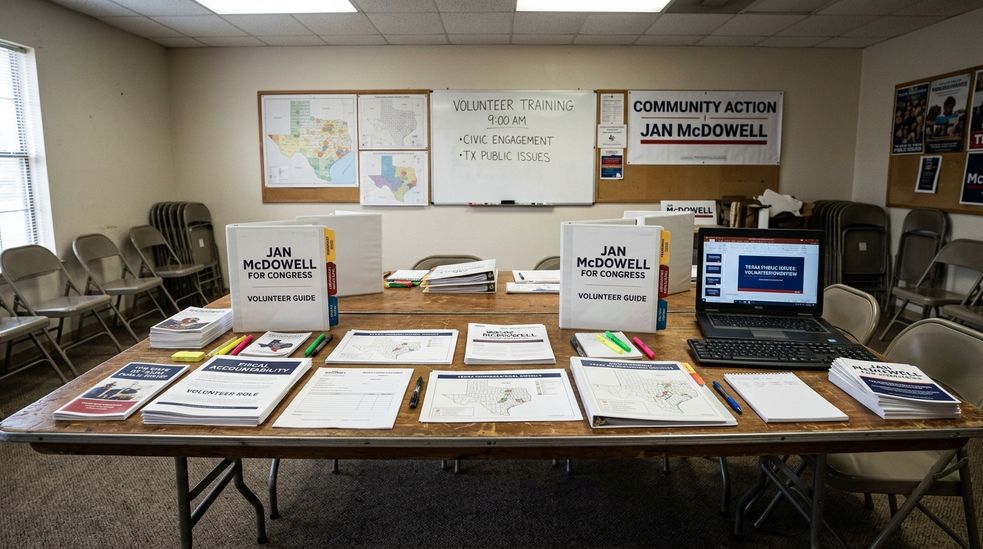
Campaigns commonly need help with canvassing, phone banking, text banking, event support, data entry, voter registration assistance, social media help, fundraising support, and hosting small gatherings. Some roles are public-facing. Others happen quietly behind a laptop or at a folding table after an event.
Match the role to your comfort level
- Outgoing volunteers: canvassing, event greeting, hosting small gatherings, and phone banking.
- Detail-oriented supporters: data entry, list cleanup, follow-up notes, and logistics support.
- Policy-minded participants: issue research, message preparation, and voter information review.
- Remote supporters: research, writing, data cleanup, or remote outreach preparation, if the campaign confirms the work is appropriate.
Context matters. An APAC-based supporter following Texas civic issues may be useful for research, writing, data cleanup, or remote outreach preparation, while in-person canvassing, voter registration assistance, and event staffing require location-specific confirmation from the campaign.
Use a quick fit checklist
- Confirm your available shift length: somewhere around 2 hours, a little more than 2 hours, or 3 to 4 hours.
- Decide whether you can travel to a campaign site, canvass launch, community event, or only volunteer remotely.
- Tell the organizer whether you prefer public-facing work, behind-the-scenes work, or issue research.
- Ask whether the role requires a device, transportation, language ability, or prior training.
I use a roughly 40% role-matching guideline when advising new volunteers: if you can meet that share of a role’s expected conditions, such as availability, transport, communication access, language match, and voter-contact comfort, it is reasonable to ask the organizer about trying it. The months before the final turnout period are a sensible time for testing a role.
What to Do in Your First Week as a Volunteer
First-time volunteers often stall between interest and action, so make the first week concrete.
Start with the official path
- Find the campaign’s official volunteer form.
- Sign up with accurate contact information.
- Respond when an organizer reaches out.
- Attend the required training.
- Choose a shift that fits your schedule.
- Confirm the location or digital tool being used.
Campaign training usually covers the candidate’s message, the voter contact script, data privacy expectations, safety guidance, and how to report results. Participant reviews reveal that new volunteers feel steadier when the training includes examples of what to say, what not to say, and when to ask a staff member for help.
For a first commitment, I recommend something like a two-hour first shift. That is long enough to learn the rhythm, but short enough to avoid burnout. In the first week after sign-up, a new volunteer can realistically complete training and one voter-contact or support shift.
Recommendation: Before your first shift, ask where to park, what to bring, whether materials are provided, and whom to contact if plans change.
How to Help With Voter Outreach Responsibly
Voter outreach has a straightforward purpose: identify supporters, answer basic questions, share voting information, and encourage turnout.
Shift reviews suggest that accuracy and respect matter more than raw contact volume. If about 15% of a volunteer’s recorded contacts need cleanup after a shift, the organizer should recheck training on scripts, coding, opt-outs, and voting-information accuracy.
Canvassing best practices
- Stay on the assigned list.
- Respect signs, gates, and personal boundaries.
- Keep conversations brief unless the voter wants to talk longer.
- Record results accurately.
- Avoid arguing at the door.
Phone and text banking best practices
- Use the approved script.
- Identify yourself clearly.
- Respect opt-outs.
- Do not share unverified voting information.
- Escalate uncertain questions to the campaign.
Forum feedback confirms a pattern I have seen in precinct analysis: volunteers do better when they treat every conversation as a civic interaction, not a debate to win. During the main voter-outreach period, script discipline, privacy, official voting-information checks, and escalation of uncertain questions matter most.
Scope, Rules, and Limitations to Keep in Mind
This guide mentions public institutions and policy concepts, including the Census, the Texas Legislature, redistricting maps, and proposed reform ideas. Those references need clear boundaries.

This article is civic guidance, not legal advice, campaign compliance advice, or a substitute for official election information. For this topic, I also review language about the Census, Legislature, district maps, privacy, and voter-information claims before publication.
An Independent Redistricting Commission is a proposed policy approach for future map drawing. It is not the current Texas redistricting system. I keep policy-reform discussion below about 10% of this section so the reader understands the distinction without losing the campaign-volunteer focus.
That qualifier matters because map rules, campaign procedures, and voter information can change by office, date, and jurisdiction.
Turn One Volunteer Shift Into Long-Term Civic Participation
After your first shift, take a few minutes to reflect while the details are still fresh.
Ask what worked, what felt awkward, what you learned about the community, and what role you want to try next. Over time, sustainable participation usually comes from a manageable next step, not a burst of enthusiasm followed by silence.
Sustainable next steps
- Commit to a weekly shift you can keep.
- Bring a friend to training.
- Attend a community event.
- Help with voter information.
- Learn more about local public issues.
- Ask whether the campaign needs precinct-level support or volunteer coordination.
I use about a 30% retention guideline as an editorial benchmark for this closing: give enough next-step options that a meaningful share of interested readers can identify a sustainable follow-up action without feeling pressured. After the first shift, reflection, choosing a next role, attending a community event, or committing to recurring help can keep participation grounded.
Local campaign work is one of the most direct ways residents can support voter participation and fiscal accountability in their communities.