
Evaluating healthcare access in Texas requires distinguishing between a physical building that remains open and the specific medical treatments that remain available inside it. When a rural hospital changes its operating status, the financial and clinical effects reach well beyond county lines, altering emergency transport routes and shifting demand toward suburban and urban medical centers, including those serving North Texas communities. A fiscal review starts by separating facility viability from service preservation.
What a Rural Hospital Closure Means for Local Care
A rural hospital closure is the cessation of inpatient hospital operations at a facility serving a rural community. In public policy discussions and news coverage, the phrase often gets applied broadly to three distinct operational events, each of which carries a different meaning for patients and local budgets.
First, a facility may undergo a complete shutdown, halting all inpatient, emergency, and outpatient operations. Second, a facility may end inpatient admissions while continuing to operate an emergency department, laboratory, or outpatient clinic; this represents a change in the service model rather than a locked building. Third, a hospital may continue admitting inpatient cases while discontinuing a specific clinical line, such as labor and delivery. Ending maternity care while keeping general medical beds open is a service-line loss rather than a full hospital closure.
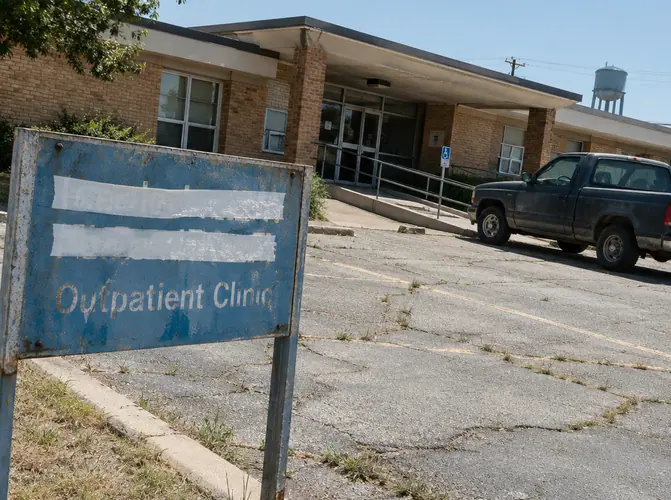
Keeping a facility financially viable and preserving local access to particular clinical services are related policy goals that require separate evaluation. A building that remains open under a reduced operating model preserves certain local jobs and stabilization capacity, yet residents still lose local access to every discontinued clinical line. Auditing what a community has retained requires a before-and-after service inventory tracked through hospital-board minutes and official facility notices.
- Emergency stabilization: 24-hour capacity to assess, stabilize, and transfer acute trauma or medical emergencies.
- Inpatient admissions: Staffed overnight beds for acute medical supervision and recovery.
- Labor and delivery: Dedicated obstetric staffing, delivery rooms, and neonatal stabilization capacity.
- Diagnostic imaging and laboratory testing: On-site radiological scans and specimen processing required both for emergency triage and routine outpatient care.
- Outpatient visits: Scheduled clinic appointments, follow-up care, and chronic disease management.
When any item leaves the local inventory, analysts trace that lost service to its new receiving location elsewhere in Texas. Mapping those destinations connects a rural hospital board's financial decision directly to patient travel burdens and capacity pressures at suburban and urban hospitals.
Why Rural Hospital Finances Become Fragile
Rural hospital budgets face a structural mismatch between relatively low patient volumes and the fixed costs of clinical readiness. A hospital cannot scale its baseline operating expenses down in direct proportion to a quiet week in the waiting room.
An emergency department operating around the clock requires clinical coverage for 24 hours each day, including overnight hours with few arrivals. Maintaining buildings, keeping life-safety systems compliant, calibrating diagnostic equipment, and holding minimum nursing and physician ratios generate continuous overhead regardless of how many patients walk through the doors.
Workforce shortages compound these fixed readiness costs. When a rural facility cannot fill permanent clinical positions locally, leadership often turns to temporary staffing agencies to maintain safe coverage ratios. Temporary staffing expenses extend beyond base clinical compensation to include agency fees, travel, lodging, and orientation time. Reviewing payroll records alongside external agency invoices and vacancy logs reveals how quickly temporary labor can strain an operating budget.
Payer Mix and Uncompensated Care
On the revenue side of the ledger, financial stability depends heavily on payer mix—the distribution of a hospital's patients across Medicare, Medicaid, private commercial insurance, and self-payment. Each payer category reimburses the hospital under different rules and rate structures. Private commercial insurers generally negotiate rates that differ substantially from the administrative rates set by public programs, meaning two hospitals delivering identical clinical procedures can record very different operating revenues depending on how their patients are insured.
Analysts reviewing hospital audits must also separate two concepts that frequently get blurred in public debate: uncompensated care and underpayment.
Separate Unpaid Bills From Low Reimbursement Rates: Uncompensated care consists of charity care and bad debt, meaning care for which the hospital receives no payment or less than the amount owed under its financial-assistance and collection policies. By contrast, a covered service paid in full at its contracted public or private rate can still generate an operating loss if that reimbursement rate falls below the hospital's actual cost of delivering the care.
When operating losses mount, leadership may cut a high-cost service line to preserve the wider institution. However, a service reduction often removes more revenue than the discontinued treatment alone. Relocating a maternity unit, for example, frequently shifts associated prenatal laboratory work, ultrasound imaging, and pediatric referrals away from the local facility and into a distant hospital system, shrinking the revenue base that supports the remaining departments.
How a Rural Closure Reaches Suburban and Urban Hospitals
When a rural facility halts inpatient admissions or closes a specialty line, the medical need does not disappear. Instead, the closure initiates a chain of events that moves patients, vehicles, and clinical workloads across county boundaries into suburban and urban healthcare corridors.

For a household, the patient journey shifts from a nearby community hospital to a distant regional medical center. Consider a clearly labeled travel illustration using example inputs rather than measured Texas travel times: replacing a 15-minute one-way trip to a local hospital with a 45-minute drive to a regional facility adds 60 minutes to the round trip before accounting for metropolitan traffic, parking garage navigation, registration, waiting rooms, or the treatment itself. That added distance creates practical burdens for working families:
- Transportation arrangements: Routine diagnostic appointments or prenatal checks require a reliable vehicle, fuel costs, or a scheduled ride service capable of crossing county lines and waiting for a return pickup.
- Time away from work: A basic lab draw or specialist follow-up that once took an hour during a lunch break can require taking a half-day or full shift of unpaid leave.
- Caregiver availability: Longer travel windows require extended childcare or eldercare coverage for dependents left at home.
- Discharge and return visits: When an inpatient stay ends at an urban hospital, family members must travel the same corridor again to bring the patient home and manage subsequent follow-up appointments.
Emergency Transport and Receiving-Hospital Capacity
Emergency transfers follow a distinct operational path that directly affects local public safety infrastructure. When an ambulance transports a critically ill patient to a distant suburban or urban emergency department, its out-of-area commitment encompasses much more than the one-way drive. The total commitment includes dispatch-to-patient travel, on-scene stabilization, transport to the receiving facility, clinical handoff inside the emergency department, vehicle decontamination, and the return journey back to the home district. While that unit and its paramedic crew are committed to a long-distance transfer, their availability to answer a second 911 call within the originating rural community drops.
At the receiving end of that highway, suburban and urban hospitals absorb the displaced volume. Pressure appears across multiple hospital departments simultaneously: emergency assessment bays hold transferred patients, on-call specialists manage additional consultations, inpatient bed coordinators search for open monitored beds, and discharge planners work to arrange safe post-hospital care for patients who live several counties away. Reviewing inter-facility transfer logs alongside ambulance turnaround records documents how a single rural closure redistributes clinical demand across a regional healthcare market.
Federal Payment Changes and the Services They Support
Federal reimbursement policy plays a central role in determining which rural clinical services can pay their own way. Evaluating federal healthcare proposals requires looking past broad funding headlines to examine what triggers a payment and which specific hospital functions that money is designed to keep open.
Policy analysts compare payment models across four consistent dimensions: the policy lever, the financial mechanism, the services supported, and the implementation responsibility.
1. Volume-Tied Encounter Payments
- Policy lever: Payment for individual visits, procedures, or inpatient admissions.
- Financial mechanism: Revenue follows the volume of eligible clinical services delivered; when patient encounters drop, revenue drops alongside them.
- Services supported: The specific emergency, outpatient, or inpatient treatments covered under the fee schedule or admission grouping.
- Implementation responsibility: Federal policymakers and administrators establish reimbursement rules and rates, while local hospital leadership organizes clinical staffing and service delivery within those financial boundaries.
2. Availability-Oriented Readiness Support
- Policy lever: Financial support tied to the continuing availability of essential community services.
- Financial mechanism: Fixed or standby-oriented payments help fund the cost of keeping doors open and staff on duty, reducing the facility's reliance on high daily patient volume to pay baseline overhead.
- Services supported: Core stabilization and outpatient functions specified by the payment arrangement, such as 24-hour emergency care and basic diagnostics.
- Implementation responsibility: Federal authorities design the payment structure, state agencies manage licensing and regulatory oversight, and local hospital boards align their service lines with the designation's rules.
3. Inpatient Capacity Support
- Policy lever: Targeted reimbursement support for maintaining acute inpatient capacity.
- Financial mechanism: Payment adjustments or cost-based structures help finance the continuous staffing, overnight beds, and clinical support required to hold admitted patients locally.
- Services supported: Overnight hospital care alongside the laboratory, pharmacy, and imaging departments required to treat admitted patients.
- Implementation responsibility: Payment authorities set the qualifying rules and reimbursement formulas, while hospital leadership manages bed capacity, nursing ratios, and clinical operations under state and federal standards.
Comparing these models clarifies a core trade-off on the campaign trail and in legislative hearings: sustaining full inpatient capacity is not interchangeable with converting a facility to a narrower emergency-and-outpatient model. A model that funds 24-hour emergency stabilization and outpatient clinics preserves vital local triage, yet any patient requiring an overnight hospital bed must still be transferred out of the community.
Medicaid Expansion Connects Coverage to Hospital Revenue
State-level coverage policy intersects directly with rural hospital balance sheets through the proportion of uninsured patients seeking care. Medicaid expansion is a policy pathway under the federal framework for extending Medicaid eligibility to more low-income adults.
From a public finance perspective, expanding eligibility operates through a specific revenue mechanism: it converts a portion of previously unpaid clinical encounters into Medicaid-reimbursed encounters. When uninsured residents gain coverage, the hospital receives reimbursement for eligible emergency and inpatient care that would otherwise be recorded as charity care or bad debt. Coverage also enables residents to seek ongoing primary care and chronic disease management through participating outpatient clinicians before a condition escalates into an expensive emergency room visit.
However, fiscal analysis requires distinguishing between two different policy actions that affect hospital budgets in separate ways:
- Expanding eligibility (coverage): Changes who qualifies for insurance coverage, increasing the share of insured patients in a hospital's payer mix and reducing the volume of unpaid care.
- Adjusting reimbursement rates (payment): Changes how much the program pays for each covered service delivered to an already-enrolled patient; by itself, a rate adjustment does not enroll an uninsured resident.
For Texas policymakers and voters evaluating Medicaid expansion, a complete fiscal review looks beyond federal matching formulas to examine state budget responsibilities and operational execution. Effective implementation depends on eligibility administration, functional application and renewal systems, local enrollment assistance, and adequate provider participation. Furthermore, analysts must track insurance coverage and local service capacity as separate metrics: enrollment records show how many residents hold an insurance card, whereas clinic schedules, staffed beds, and clinician vacancy rates determine whether those residents can actually find care close to home.
Pair Telehealth With Broadband, Clinics, and Transport
Telehealth frequently appears in healthcare proposals as a practical tool for bridging rural clinical gaps. Used appropriately, remote care handles several concrete clinical tasks effectively: routine follow-up appointments, behavioral health counseling, chronic medication management, and subspecialty consultations that would otherwise require a multi-hour drive.
Delivering those virtual visits reliably requires physical and administrative infrastructure at both ends of the connection. A home-based telehealth visit requires that the patient possess a suitable camera-enabled device, dependable high-speed connectivity, a private space to discuss medical issues, and a reliable path to receive follow-up instructions or prescriptions. When any of those elements is missing at home, a clinic-supported telehealth model provides a practical alternative.
In a clinic-supported pathway, the patient travels to a local rural clinic where nursing staff record vital signs, perform required physical examinations, collect laboratory specimens, and connect the patient to a remote specialist via the clinic's dedicated broadband line. Following the remote consultation, the local clinic staff route test results back to the consulting physician and coordinate local referrals.
Audit Physical Care Alongside Virtual Access: Telehealth cannot replace emergency stabilization, surgery, or other care requiring an equipped physical facility; any credible rural access plan must identify the physical destination and transportation arrangements for those in-person services.
Because a municipal broadband grant addresses a completely different operational need from a clinic's nursing payroll or a county transit service's dispatch schedule, fiscal reviewers evaluate telehealth proposals by checking whether all three links—connectivity, local clinical staffing, and patient transport—are funded together.
Ask What the Local Hospital Access Plan Keeps Within Reach
Meaningful voter participation and civic oversight happen in county commissioners' courts, hospital-district boardrooms, and town halls where healthcare budgets are debated. When officials or candidates present a plan to restructure a troubled facility or preserve rural healthcare access, residents, local journalists, and civic volunteers can evaluate the proposal by requesting specific operational documents—namely the before-and-after service inventory, the proposed operating budget, and the written transfer and transportation agreements.
Taking the following checklist to a public meeting moves the conversation past general assurances and focuses scrutiny on what the plan actually delivers:
- Service retention and displacement: Which exact clinical services (inpatient beds, emergency room, labor and delivery, imaging, lab) will remain available locally, where will displaced services be delivered, and which named entity coordinates referrals and emergency transfers?
- Staffing and readiness financing: How does the proposed operating budget pay for 24-hour clinical staffing and emergency readiness, and how much does the plan rely on temporary agency labor versus permanent hires?
- Policy and appropriation dependencies: Which specific federal payment designations, state legislative actions, or local tax appropriations must be approved for the budget numbers to work?
- Wraparound operational pathways: Does the operating plan fund non-emergency patient transportation, follow-up scheduling, test-result communication, and a clinic-assisted access route for residents without reliable home internet?
A video connection can link a rural patient to a specialist hundreds of miles away, and an outpatient clinic door can stay unlocked for daytime visits, yet emergency surgery requires an operating room and an in-person clinical team.