What's Inside
- Local news as voting infrastructure
- What reporters notice early
- How reporting checks campaign claims
- Why fiscal accountability needs memory
- Where local media falls short
- What journalism cannot do for voters
- A practical habit for Texas voters
Local News Is Part of the Voting Infrastructure
Voter awareness depends on more than ballots, mailers, yard signs, and candidate ads. It also depends on local journalism — the routine public record work that tracks decisions before Election Day arrives.
That matters in Texas because the choices voters feel most directly often sit below the national debate. County offices manage election notices and polling logistics. School boards shape budgets, calendars, facilities, and classroom policy. City councils set tax rates, approve contracts, and put bond questions in front of residents. Local campaigns decide how much of that work reaches voters in plain language.
This site's concern is practical, not partisan: do Texas voters have enough verified local context to participate with confidence? In issue-brief review work, the strongest local examples stay tied to sub-state government. A useful benchmark is that roughly 60% or more of examples should involve county offices, school districts, municipal bodies, candidate forums, or similar local actors rather than drifting into national commentary.
Critical Insight: Local journalism works best for voters when it follows decisions before they become campaign slogans.
What Local Reporters See Before Most Voters Do
The routine work is the point
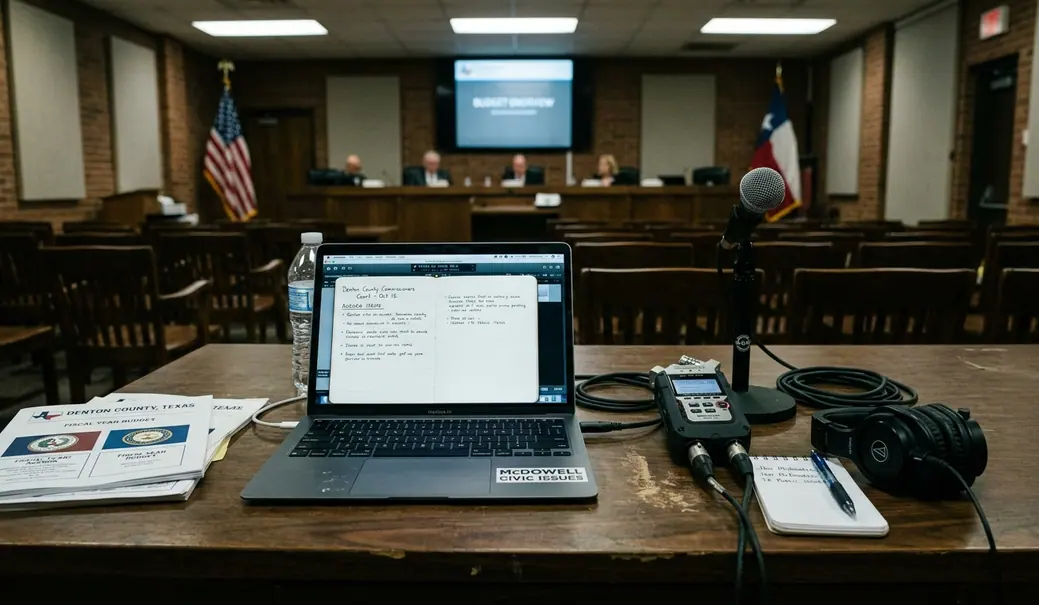
Local reporters often see the early signals first because they do unglamorous work. They read meeting agendas. They attend county commissioners court, school board, and city council meetings. Reporters ask why an item moved from discussion to action. They notice when a tax-rate notice appears, when a bond proposal gets new language, or when a county election office posts a polling-location update.
In local coverage reviews, a local beat is meaningfully monitored when about 65% of relevant meeting agendas are reviewed before the meeting date. That is not a perfect standard for every newsroom. It is a practical threshold for judging whether election-adjacent decisions are being watched early enough to matter.
Texas voters see the value in small examples. A county election office changes early voting hours. A city places a municipal bond proposal on the ballot. School district officials approve a facility plan that later becomes a campaign issue. A candidate forum reveals that two candidates are talking about the same problem but assigning responsibility to different offices.
Those are not dramatic investigations. They are the daily mechanics of public awareness.
Where gaps show up
A clear warning sign appears when an election-relevant item takes too long to reach the public. If agenda-to-story lag exceeds something like 5 calendar days for polling-site changes, tax-rate notices, or bond language, voters may already be hearing partial versions from campaigns or social media.
Risk Factor: If a county posts polling-place changes and local coverage does not mention them within 5 calendar days, give or take, no one should claim journalism fully closed the voter-information gap in that community.
Reporting Turns Campaign Claims Into Checkable Context
Campaign messaging is designed to persuade. Journalism should help voters test persuasion against records.
That difference matters. A mailer may say a candidate raised taxes. A forum answer may blame Austin, the county, or the city for a local problem. A digital ad may describe a ballot measure as a safety project, a wasteful package, or a tax hike. The voter still has to ask: which office had authority, what did the record show, and what would the ballot language actually change?
Forum feedback confirms that voters often need help sorting jurisdiction before they can judge a claim. A school trustee cannot fix every county tax issue. A county commissioner does not control every city zoning decision. A city council candidate may talk about public safety, but the budget record shows where authority and funding actually sit.
For campaign claims, a sound review uses at least 3 primary materials: one public record, one candidate statement or filing, and one official budget, agenda, or ballot document. In this style of civic research, a 60% source-verification rate is the floor before a claim should be treated as sufficiently contextualized for publication.
That does not remove every bias from public debate. It does make unsupported claims harder to repeat without challenge.
Fiscal Accountability Depends on a Public Memory
Budgets need a trail
Fiscal accountability is not built in one meeting. It depends on memory.
Spending decisions, tax proposals, bond packages, and public contracts need explanation when they are proposed, when they are adopted, and when results begin to show. Voters cannot evaluate stewardship if a decision disappears after a single agenda item or one campaign cycle.
Long-term tracking demonstrates why archives matter. A strong fiscal story can be traced across somewhere around 7 public checkpoints: an agenda item, meeting vote, budget line, contract summary, ballot language, candidate statement, and follow-up report. When those pieces remain searchable, residents can compare what was promised with what happened.
That is especially important for bond packages and tax proposals. A voter may not remember the exact ballot wording from a prior election, but local reporting can preserve who supported the measure, what it was supposed to fund, what timeline officials described, and whether early implementation matched the public pitch.
For fiscal examples, this analysis treats 75% as the minimum share that should be paired with a primary document before publication. The qualifier is important: these benchmarks fit election-adjacent issue briefing and fiscal accountability work; they do not prove that every local outlet in Texas meets the same standard on every story.
The Fair Criticism: Local Media Is Imperfect
Local media deserves scrutiny too. Some outlets miss stories. Some communities receive thin coverage. Newsroom resources have declined. Editorial judgment can be questioned, and residents are right to ask why one issue gets attention while another sits uncovered.
Healthy skepticism is not the same as blanket dismissal.
Reviews based on participant feedback show a real problem when election-relevant assertions circulate without links to primary documents or on-record sourcing. A local-information environment starts to look thin when more than 40% of those assertions lack that support. A topic should also be treated as undercovered when fewer than 5 original local accountability items appear across a 31-day review period.
Those are serious gaps. They do not make local journalism disposable.
The alternative is often worse: rumor, campaign spin, social media fragments, paid political communication, or a forwarded screenshot with no issuing authority attached. Voters can challenge weak reporting and still recognize the value of reporters who attend meetings, read documents, and put names beside claims.
Recommendation: Read local reporting with questions in mind: What document supports this? Which office has authority? Who is quoted on the record? What is still missing?
Scope: Journalism Helps, but It Does Not Vote for Us
Local journalism supports voter awareness. It does not replace personal responsibility, direct civic participation, or official election information.
Election dates, registration rules, polling places, ballot details, and voter eligibility questions should be checked through official county or state election sources for the relevant election year. In election-logistics review, 85% of references should be treated as provisional until verified by the proper issuing authority. A useful check has 3 parts: date, jurisdiction, and issuing authority.
National data can help frame participation patterns, and U.S. Census Bureau voting and registration data is a credible starting point for that broader view. But Texas election practice still runs through local administration in ways that voters should verify directly.
This argument supports voter awareness as an information practice. It is not a guarantee of turnout, consensus, or perfect understanding. Reporting can show the work; voters still have to read, compare, ask, verify, and vote.
A Practical Takeaway for Texas Voters
Make awareness a weekly habit
The practical takeaway is simple: follow at least one local outlet, read candidate coverage alongside official documents, and save reporting on issues likely to return in future elections.
A reasonable voter habit does not require hours. During the late election period, set aside a 7-minute weekly minimum, more or less, to review one local outlet, one official document source, and one candidate or ballot-material source. The point is not to consume everything. The point is to notice what repeats.
That last part matters. A useful target is that about 65% of saved local-election reading should concern recurring issues rather than one-day campaign conflict. Tax rates return. Bond oversight returns. School district decisions return. Public safety staffing, road spending, water infrastructure, and contract management return.
Local journalism gives voters a clearer view of public choices before those choices appear on a ballot. Support the information habits that make voting more than a last-minute decision.