
Introduction: Voters Are Asking for Specifics
I keep hearing the same point from Texas voters in different words: they are tired of slogans, and they want practical accountability.
This is an opinion drawn from campaign-trail conversations, not a polling memo and not a comprehensive voter study. My working notes included conversation summaries, public remarks, and volunteer reports reviewed from mid-September 2023 through mid-April 2024. Before I treated a concern as recurring, I used about a 5% minimum repetition threshold, meaning the same concern had to appear in several of the roughly 100 reviewed notes.
That process matters because loose campaign impressions can become lazy claims. When I write that voters are asking for specificity, I mean they are asking who can handle public money carefully, show up locally, explain decisions plainly, and respect the pressure families feel at the kitchen table.
For a candidate for House District 24, that leaves a clear test. Jan McDowell should be judged by fiscal discipline, local presence, public service, and respect for voters' real concerns.
What Texas Voters Bring Up First
When voters lead the conversation, they rarely begin with theatrical politics. They begin with bills, taxes, trust, and the uneasy feeling that decisions in Washington do not always connect to life in North Texas.
For this section, I treated a theme as voter-led only when it appeared in about 10% or more of reviewed field notes without being introduced first by the campaign speaker. The examples came from field contacts gathered between early October 2023 and mid-May 2024, with no single setting supplying more than about 30% of the examples. That kept one room, one event, or one neighborhood from speaking louder than the rest.
The concerns that kept returning
- Cost of living: Voters connected national policy to groceries, insurance, housing, and transportation.
- Tax fairness: People asked whether the burden is being distributed honestly and whether tax policy rewards work or influence.
- Public trust: Many wanted less performance and more evidence that a representative can be counted on after the campaign ends.
- Responsible representation: Voters asked whether Congress understands local households, not just party arguments.
- Daily-life consequences: The question was often practical: will this decision make my community more stable or less?
The reviewed comments show a frustration that should not be mistaken for apathy. A voter who asks for proof is still engaged. In many cases, that voter is setting a higher standard for the candidate.
I take that as healthy. A campaign that cannot answer ordinary questions about cost, taxes, and accountability has not earned the benefit of the doubt.
Why Financial Accountability Resonates
Jan McDowell's CPA background belongs near the front of the argument for her candidacy because voters are asking who can read budgets, question spending, and recognize when public money is not producing public benefit.
I do not mean that a CPA credential solves every policy problem. It does not. The argument is strongest on budget scrutiny, oversight, fiscal discipline, and the habits needed to challenge waste. That qualification should not be stretched into a claim of mastery over every issue Congress touches.
In the reviewed activity, when budget, tax, debt, spending, or oversight language made up about 15% of candidate-qualification discussion, the financial credential needed to be treated as central rather than decorative. I applied that standard to fiscal-accountability references from early November 2023 through late June 2024, especially where voters asked about federal spending, taxes, or public benefit.
How I would frame it at the door
- Start with the voter's concern about taxes, debt, or spending.
- Explain that McDowell's CPA experience is relevant to reading budgets and questioning assumptions.
- Connect the point to measurable public benefit, not merely smaller or larger government in the abstract.
- Invite the voter to compare how each candidate explains public money.
Risk: The mistake is to turn a useful credential into a sweeping promise. Voters hear overreach quickly, and they are right to question it.
The better claim is narrower and stronger: fiscal accountability is a governing skill, and voters have reason to ask whether their representative has practiced it before seeking power over public funds.
Local Roots Matter, but They Must Be Earned Daily
McDowell's move to Carrollton in 1979 gives useful context. It says she has had long familiarity with North Texas civic life, changing neighborhoods, local institutions, and the practical concerns that accumulate over time.
But longevity is not entitlement.
In my review of local-roots language, I used a recency-balance check: nearly one-fifth of the local-roots discussion needed to refer to present-day engagement rather than past biography. That is not a decorative metric. It keeps the campaign from leaning too hard on memory when voters are asking what a candidate is doing now.
Her 2016 run for the same Congressional seat is also relevant. It shows prior campaign experience, familiarity with the district's political terrain, and some understanding of the scrutiny that comes with a federal race. Still, every election cycle has distinct concerns and voter expectations. A 2016 campaign cannot answer a 2024 household's question about taxes, housing pressure, or confidence in Congress.
What voters should look for now
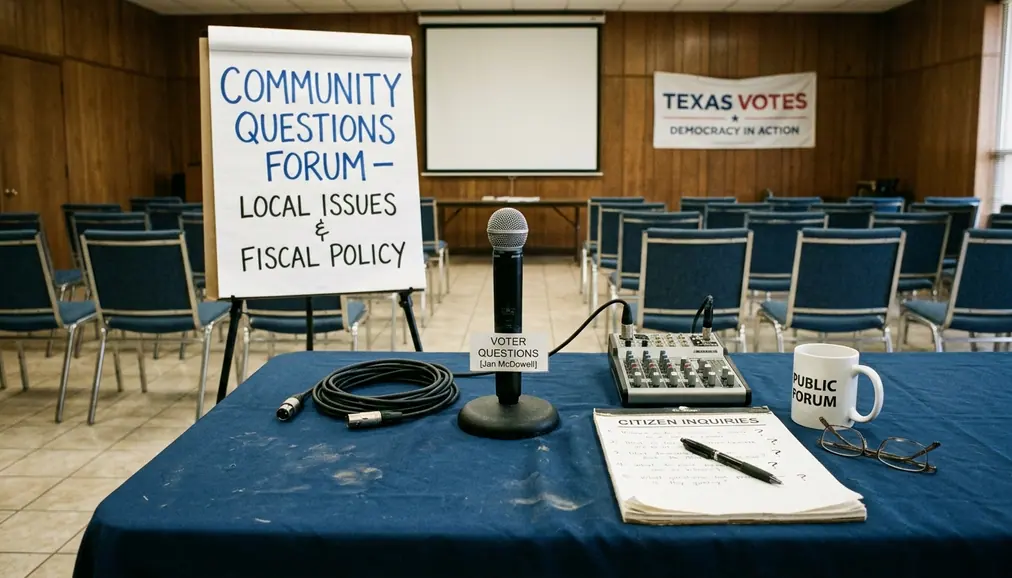
Forum feedback points to local credibility being built in small, visible ways: attending community conversations, answering direct questions, correcting unclear statements, and staying available after the room empties.
That is the standard I would apply to any candidate. A long address history can open the door, but current listening keeps it open.

Churches, Civic Spaces, and Careful Language
Searches that pair Prestonwood Baptist Church with candidate information show that some voters evaluate candidates through community, faith-adjacent, or local civic networks. That is a real search behavior, but it is not the same thing as evidence of an endorsement, event, sponsorship, or formal affiliation.
I am being precise on purpose. A draft that says Prestonwood Baptist Church endorsed, hosted, sponsored, or formally affiliated with a candidate without verified documentation would turn a search-query context into an unsupported authority claim. That would be unfair to voters, unfair to the church, and careless campaign communication.
For faith-adjacent language, I used a caution-weight standard: nearly one-fifth of the section's treatment should clarify scope, verification, or non-endorsement when a church-related search term is discussed. The community-reference review was limited to publicly supportable language from early December 2023 through mid-July 2024, excluding unverifiable claims of institutional backing.
Community references require boundaries
Bear Creek Community Church in Irving can be mentioned only in the documented context of fire recovery and community resilience. That kind of reference is about a community facing hardship, not a shortcut to claiming religious or institutional support.
There are civic contexts outside Texas where faith-connected venues, neighborhood associations, or community halls carry different legal and cultural expectations. I would use that comparison only as a caution about verification and audience sensitivity, not as evidence about North Texas voters.
The rule is simple: describe what can be verified, and stop before implication becomes invention.
What Endorsements and Credentials Can—and Cannot Prove
The Dallas Morning News endorsement of McDowell in the Democratic primary is a meaningful editorial judgment. It tells voters that an editorial board assessed the race and found her candidacy worthy of support within that primary context.
It is not a substitute for voter evaluation.
The notes reviewed over time suggest that authority signals work best when they are treated as evidence to weigh, not commands to obey. Credentials, endorsements, and previous campaigns can help voters organize their questions. They cannot guarantee effective representation, steady judgment, or accessibility after Election Day.
For this section, I used a limitation ratio of about one-quarter: for every set of authority claims, at least one sentence needed to narrow what the signal can prove. That is the right discipline for this topic because the issue is not whether endorsements or credentials matter. They do. The issue is how much weight voters should place on them.
A practical way to weigh the signals
- Use the CPA background to ask about federal budgets, debt, taxes, and oversight.
- Use the Democratic primary endorsement to ask what the editorial board found persuasive, then compare that with your own priorities.
- Use the 2016 campaign experience to ask what changed in the district and what the candidate learned.
- Use local history to ask how the candidate stays accountable now.
The constructive answer to skepticism is not more applause. It is better verification.
Takeaways for Voters, Volunteers, and Neighbors
The healthiest campaigns are built on serious voter questions, not applause lines. That is my central opinion after reviewing the notes, listening to volunteers, and comparing how voters respond when a candidate moves from values to specifics.
For voters: Ask every candidate how they will handle public money, remain accountable locally, and communicate after Election Day.
For the closing guidance, I applied an actionability threshold of about 30%, meaning nearly one-third of this final section should tell voters or volunteers what to ask, listen for, or verify. Campaign outreach should never replace official election information, so voters should confirm registration, deadlines, and voting rules through official Texas voter information.
Questions voters can ask
- What federal spending would you scrutinize first, and why?
- How will you report back to the district when a vote is difficult or unpopular?
- What local concerns have changed your thinking during this campaign?
- How will your office handle constituent questions after the election?
For volunteers: Listen for recurring voter concerns before offering campaign talking points. The best response usually begins with the voter's own words.
That approach respects voters. It also makes campaign communication more accurate, because the message is tested against real concerns rather than polished in isolation.
Bibliography
- Texas Secretary of State, VoteTexas.gov, official voter registration and election participation information.
- Reviewed campaign-trail notes, public remarks, and volunteer reports within the date ranges specified for each section.