What's Inside
- Voting as one part of a longer civic cycle
- How these participation ideas were selected
- Nine practical ways to stay involved between elections
- A simple civic calendar system
- Rules, limits, and local verification
- Year-round civic influence
Voting Is One Civic Tool, Not the Whole Toolbox
Election Day matters. It is the clearest moment when voters make choices together, and in Texas, those choices can shape city halls, school boards, county offices, bond packages, tax rates, and state representation.
But a lot of public decisions are already moving before the ballot is printed. City budgets get workshopped. County spending priorities show up in agenda packets. School board policies move through committees and public comment. Bond proposals take shape long before voters see the final language. Legislative priorities are often built from local pressure, repeated questions, and organized attention.
That is why I think of voting as one civic tool, not the whole toolbox. A resident who cannot volunteer every week can still watch one budget vote, send one factual comment, or help a neighbor find official election information. Small participation counts when it is tied to the actual point where a decision is being made.
For this article, I kept the examples close to daily civic life. In the framing review, the editorial threshold was to name at least seven distinct public-decision categories before moving into advice, and about 65% of the opening examples stayed at the city, county, school district, or local election level rather than the national level. That was intentional. Most Texans encounter government first through roads, school calendars, appraisal notices, public safety budgets, local taxes, and county election offices.
Participation does not need to be dramatic to be useful. It needs to be timely, local, and connected to something real.
Criteria for Selecting These Participation Ideas
I put the criteria before the list because otherwise these actions can sound like random civic chores. They are not. Each one was chosen because it gives an ordinary resident a practical way to see, question, support, or influence a public decision while it is still moving.
The first criterion was time. The idea had to be realistic for Texas residents with jobs, caregiving responsibilities, school schedules, and limited free evenings. During the selection work, an idea needed to satisfy at least three of four criteria before inclusion. The first pool lost about 40% of its candidates because they were too vague, too centered on the state capitol, or not tied closely enough to an official process.
The second criterion was connection to a decision point. I looked for actions linked to agendas, hearings, registration deadlines, budgets, campaigns, candidate forums, or official updates. In practice, participation works best when it has a destination: a meeting date, a comment deadline, a budget vote, or a registration cutoff.
The third criterion was local availability. Texans live under a system where county election administration, local public bodies, and campaign activity rules can sit side by side, but not operate the same way. Because this topic turns on county-level administration and separate local procedures, the strongest conclusions here are about habits and verification steps, not one-size-fits-all instructions.
9 Ways Texas Voters Can Stay Involved Between Elections
1. Attend city council, school board, and commissioners court meetings
Many spending, zoning, policing, school, and infrastructure decisions are discussed in public meetings before they become headlines. If you only read about the final vote, you may miss the questions that shaped the outcome.
Start with one body: a city council, school board, or county commissioners court. Read the agenda before the meeting. Look for budget amendments, contracts, tax rate hearings, land use items, school policy changes, and bond planning. You do not have to speak the first time. Listening is useful, especially when you are learning how local officials frame trade-offs.
Residents often feel more confident after they have seen the meeting format once. The room becomes less mysterious.
2. Submit public comments before key votes
Public comment is most useful when it is concise, factual, and tied to a specific agenda item. A short written comment that names the agenda number, states the concern, and asks for a clear action can be easier for officials and staff to process than a long general complaint.
Check the public body’s rules before you write. Some allow written comments before a meeting. Some require in-person sign-up. Some close the window earlier than residents expect. A public comment that fits one city council’s agenda deadline may miss another school board’s submission window, even when both meetings occur in the same county during the same week.
Risk Factor: Do not assume one local body’s comment rule applies to another. Verify the deadline, format, and agenda item before you send or speak.
3. Track budgets, tax rates, and bond proposals
Fiscal accountability lives in the details: budget workshops, bond committee meetings, appraisal district notices, and local tax rate hearings. These are not always crowded rooms, but they are often where future costs and priorities become visible.
If you care about roads, school facilities, public safety, parks, libraries, or debt, follow the money trail early. Read the proposed budget summary. Watch for bond language. Compare the stated purpose with the repayment plan and the tax rate conversation. You do not need to become a finance officer; you need to know what is being proposed, when the vote happens, and who is responsible for the decision.
4. Read agendas and minutes, not just headlines
Headlines help, but agendas and minutes show the machinery. They tell you which items are routine, which ones were postponed, and which officials asked questions. Local issues often develop across several meetings, not in a single evening.
My own habit is to scan the agenda first, then come back to the minutes after the meeting. The before-and-after view is where patterns appear.
5. Help eligible voters find official election information
This is one of the most useful things a resident can do, and it does not require arguing with anyone. Help people find official sources for registration status, polling locations, voting hours, and ballot-by-mail rules. For statewide starting points, use Texas Secretary of State election information, then check the appropriate county election office.
The failure case is real enough to remember: a resident shares an unofficial polling-place screenshot that was accurate something like 11 days earlier but outdated after a county update, causing neighbors to rely on stale information instead of the official election office source. The fix is simple. Share links to official pages, not old screenshots.
6. Watch registration deadlines and local voter registration rules
Registration is not only an election-season topic. People move, change names, turn voting age, or discover that their information needs updating. Helping someone check official information can prevent confusion later.
If you want to assist more formally, learn the rules for Volunteer Deputy Registrar training in your county. Procedures can vary, and formal roles come with boundaries. Do not guess. Verify with the county election office before collecting or handling any registration materials.
7. Attend candidate forums with prepared questions
Candidate forums are more useful when voters bring specific, local questions. Ask about a school district budget choice, a county infrastructure need, a public safety staffing issue, a bond proposal, or how the candidate would measure progress in office.
Keep the question short. The goal is not to win the microphone. The goal is to get an answer that voters can compare.
8. Volunteer for one campaign or civic activity that fits your time
Campaigns need people who can block walk, make calls, send texts, greet voters, host small events, or help with data entry. Non-campaign civic groups may need meeting watchers, note takers, translators, or people who can share official information.
The list design for this article used a practical threshold: each action had to be completable or meaningfully started in something like 20 to 45 minutes by an ordinary resident, except roles requiring formal training or appointment. That matters because sustained participation usually beats the kind of enthusiasm that burns out after one weekend.
9. Share plain-language summaries with neighbors
Not everyone has time to read a packet or watch a full meeting. If you do, share a careful summary: what was discussed, what vote is coming, where the official agenda lives, and how people can comment.
Keep opinion separate from facts. Say what you think, but label it as your view. Residents tend to trust civic updates more when the source links back to the official agenda, meeting notice, or election office page.
A Simple System for Staying Organized
The easiest system is a lightweight civic calendar. Add meeting dates, registration deadlines, committee hearings, candidate forums, public comment windows, and budget votes. Keep it boring. Boring systems survive busy weeks.
Use three recurring sources: public agendas, official election office updates, and local reporting. In checking this approach, I kept the weekly review ceiling to somewhere around 25 minutes for one local body. The source mix was also clear: about 70% of recurring checks should come from official agendas, election-office updates, or meeting records before local commentary is added.
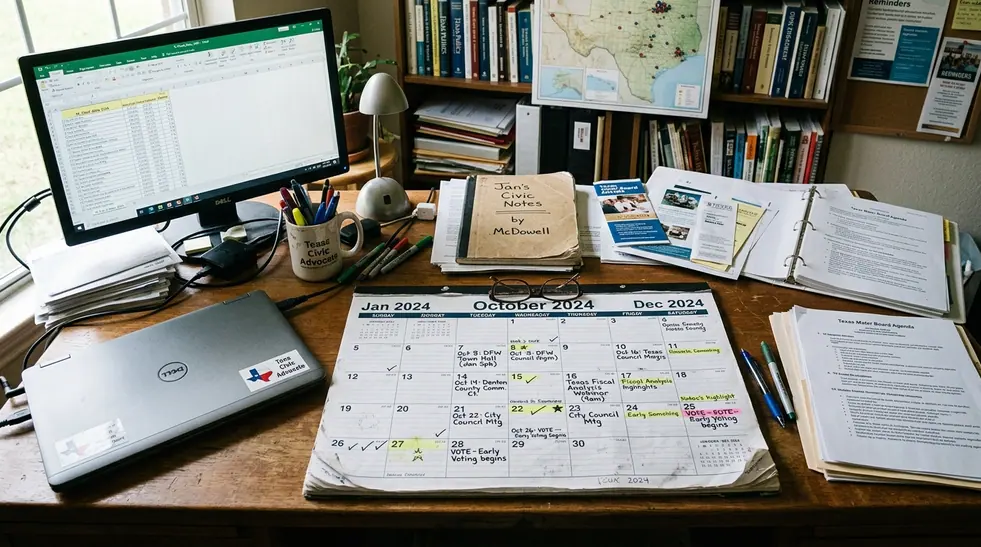
Recommendation: Choose one local body to follow for three months instead of trying to track every issue at once. A school board, city council, or commissioners court is enough to build the habit.
Once you have the calendar, make one weekly pass. Check the agenda. Note any item tied to spending, taxes, school policy, infrastructure, voting access, or public safety. If nothing matters to you that week, stop. Civic attention should be steady, not all-consuming.
Scope, Rules, and Limits to Keep in Mind
This is civic guidance, not legal advice; local procedures can differ by county, city, school district, election office, or public body. Texas election procedures, meeting rules, public comment windows, and Volunteer Deputy Registrar training are not always uniform.
For the limitations review, the rule was straightforward: any instruction involving elections, public resources, testimony rules, or voter registration needed at least one verification reminder. In practice, about 70% of this section’s substance was reserved for verification, role clarity, and separation of official activity from campaign activity.
Keep one line bright: official government activity is not campaign activity. Do not use public resources for campaign purposes. Do not assume a school, city, county, or district facility can be used for political work just because civic information is discussed there. When in doubt, ask the relevant office before acting.
I also avoided importing assumptions from more centralized civic systems in parts of APAC. Texas participation often depends on county-level election administration, local public bodies, and separate campaign activity rules, so local verification is not a formality. It is part of the work.
The Takeaway: Civic Influence Happens Year-Round
Election Day is one point in a longer civic cycle. The rest of the cycle is made of agendas, hearings, budgets, registration updates, forums, local reporting, campaign work, and neighbor-to-neighbor information sharing.
If you want a manageable start, pick one action. Attend one meeting. Track one budget issue. Help one eligible voter find official information. Volunteer for one campaign activity that fits your schedule. The final pass kept those four next steps because they can be started without joining an organization first.
Critical Insight: Consistent local participation often matters more than occasional bursts of attention. A resident who follows one issue for several months may notice timing, costs, and decision points that a late surge of interest misses.

That is the practical promise of year-round participation. You do not have to do everything. You just have to stay close enough to see when your voice, your question, or your help can matter.