A civic opinion on why North Texas leaders must listen across party, language, and income lines to represent diverse constituents well in practice.
Rachel WhitcombPrincipal Public Policy Analyst
What's Inside
Representation Begins Before a Vote Is Cast
Diversity Is the Governing Reality, Not a Talking Point
Good Listening Has to Be Structured
Listening Does Not Mean Governing by Poll
The Test Is What Happens After People Speak
The Limits of Listening Are Also Worth Naming
What North Texas Voters Should Expect
Representation Begins Before a Vote Is Cast
A civic duty, not campaign etiquette
I start from a simple civic premise: in a region as varied as North Texas, listening is not optional etiquette — it is part of legitimate representation.
That premise matters before any ballot is cast. A candidate who listens only in the final 60 days, give or take, before voting has already missed the ordinary texture of public life: the school pickup line, the renter facing a renewal notice, the small business owner reading a tax bill, the retiree trying to reach a clinic, and the resident who no longer trusts politics enough to attend a public meeting.
The responsibility should be continuous. From early May 2023 through Election Day 2024, constituent listening should be treated as public work, not as a seasonal campaign tactic. It should account for geography, income, language access, partisan disagreement, distrust of politics, transportation limits, and the fact that many residents work when public meetings are usually scheduled.
The point is direct: elected officials and candidates should build a steady practice of hearing constituents, testing what they hear against public facts, and explaining how that input shapes decisions.
Diversity Is the Governing Reality, Not a Talking Point
One region, many public experiences
North Texas is not one kind of place. It includes dense urban neighborhoods, older suburbs, fast-growing communities, rural edges, immigrant families, long-time residents, homeowners, renters, students, retirees, and small business owners. A single listening method cannot reach all of them.
Census-style data helps ground that point. The U.S. Census Bureau QuickFacts for Dallas County, Texas reflects a county with substantial demographic and economic variation. American Community Survey 5-year data for 2018 through 2022 reported, subject to publication-date verification, that 41.2% of Dallas County residents spoke a language other than English at home and 24.1% were foreign-born.
Those numbers are not decoration. They change how public questions should be heard.
Transportation policy looks different to a commuter with a reliable car than to a shift worker dependent on bus frequency. Property taxes feel different to a retired homeowner on a fixed income than to a renter whose lease absorbs rising costs. Health access, public schools, public safety, and voting rights do not land evenly across neighborhoods.
When variation changes the policy question
A useful rule is to treat variation as meaningful when a county, city, or precinct-level measure differs by about 10 percentage points from the district baseline. That threshold does not answer the policy question by itself. It tells a serious officeholder to ask whether a public decision may have uneven consequences.
In practice, format matters as much as turnout. A weekday town hall with something like 30 attendees from the same neighborhood can produce earnest, specific testimony and still miss renters, shift workers, students, language-minority residents, and people without reliable transportation.
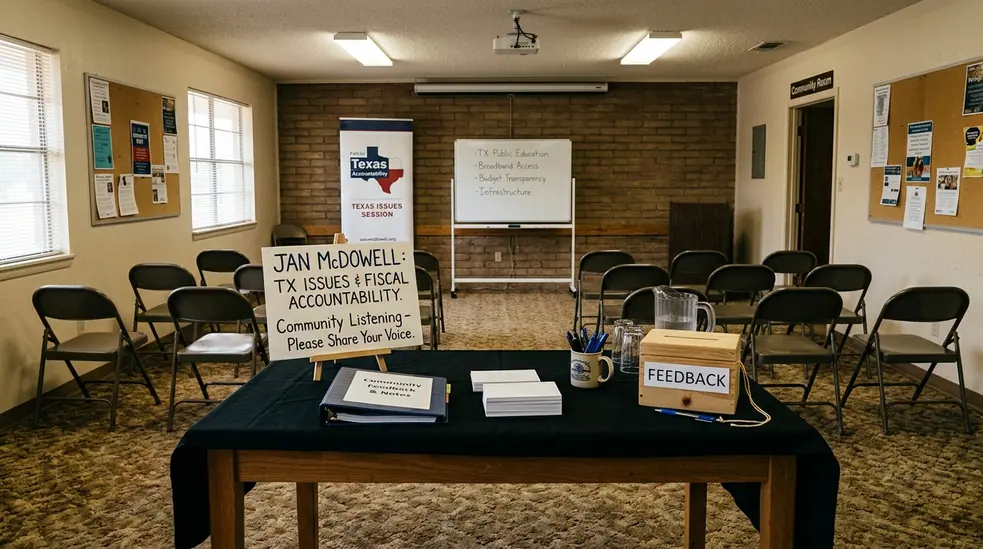
Residents gathered for a community listening session where small-group conversation can surface local concerns that a single microphone line may miss.
Good Listening Has to Be Structured
Channels should match residents, not staff convenience
Listening cannot depend only on who can attend a weekday evening town hall or who already knows how to contact an office. That approach rewards confidence, free time, transportation, English fluency, and familiarity with public systems.
A better structure uses several channels at once:
Neighborhood meetings held in different parts of the district.
Phone calls for residents who prefer direct conversation or lack reliable broadband.
Small-group conversations where quieter participants can speak without performing for a room.
Volunteer canvassing notes sorted by issue and geography.
Accessible online forms, including multilingual options where needed.
Visits to civic associations, school events, faith communities, and local business groups.
Follow-up after public events so residents know their comments did not disappear.
Context matters. A multilingual online form may improve access in one part of North Texas, while another area may require phone calls, civic association visits, or paper follow-up because broadband access, trust in institutions, and preferred languages differ.
Recommendation: Based on participant logs, leaders should track repeated concerns by issue and geography while protecting personal privacy. As a working rule, an issue should be treated as repeated only after at least 9 independent resident contacts from at least 3 distinct geographic clusters, with no single channel supplying more than about 60% of the entries.
Common mistakes and practical fixes
The most common mistake is mistaking volume for breadth. A loud room, a long email thread, or a stack of identical messages may signal intensity, but it may not show how widely a concern is held.
A fixed review window helps. Reviewing logs over several months, for example from mid-August 2023 through late February 2024, can separate longer-running concerns from campaign-season spikes. Public feedback points to a related issue: residents are more likely to keep participating when the office can tell them what was heard, what remains unresolved, and when the next review will occur.
APAC-style public consultation practices can offer useful lessons about multilingual access and dense urban outreach, but Texas election norms, public-record expectations, and local jurisdictional boundaries should control the recommendations here.
Listening Does Not Mean Governing by Poll
The counterargument deserves an answer
Some people worry that too much listening makes leaders timid, inconsistent, or captive to whichever group speaks last. The concern is not frivolous. Public decisions can become distorted when organized pressure is treated as the whole public will.
That is why listening must be distinguished from surrendering judgment. Officials are elected to decide. They should decide with an honest understanding of who will be affected, what law permits, what the budget can sustain, and which trade-offs are being made.
Risk factor: If about 55% or more of comments on an issue arrive through one organized contact path within two weeks or so, that input should be treated as mobilized testimony rather than proof of district-wide consensus.
Disagreement is not a failure of listening. In a diverse region, disagreement is often evidence that the real policy question has finally been reached. The failure comes when disagreement is dismissed without examination because it is inconvenient, partisan, emotional, or unfamiliar.
Judgment still has to be visible
Resident feedback often points to a recurring civic expectation: residents do not require every decision to go their way, but they do want leaders to explain how competing claims were weighed. A decision-review span from early January 2024 through mid-May 2024 can help compare early, mid-cycle, and late input before a position is described as stable.
That kind of review does not make leadership mechanical. It makes reasoning traceable.
The Test Is What Happens After People Speak
Input without feedback becomes extraction
Constituents deserve to know whether their concerns were heard, even when the final decision does not satisfy everyone.
The public test is not whether a leader hosted a meeting. The test is whether residents can see a line from what was said to what was studied, prioritized, revised, or rejected. That line should be plain enough for a voter to follow without needing insider knowledge.
Public feedback loops can be simple. Summarize major themes from conversations. Explain how those themes shaped priorities. Identify when legal, budgetary, or jurisdictional limits apply. Name what can be done now, what requires another level of government, and what needs a longer timeline.
A concern category should be summarized when it reaches about 5% of logged contacts or appears in at least 5 separate neighborhoods, whichever threshold is met first. After a listening period, a feedback summary should be published within roughly three to four weeks, such as early November through early December 2023, while residents can still connect their comments to the decision.
Key point: Listening earns trust only when followed by visible reasoning and honest follow-through.
Over time, trust is built in small public acts: returning a call, correcting a misunderstanding, admitting a constraint, and showing that a resident did not have to be politically connected to be taken seriously.
The Limits of Listening Are Also Worth Naming
Honesty is part of representation
No leader can personally hear every resident, solve every issue immediately, or make every constituent agree. Saying so does not weaken the listening standard. It makes the standard credible.
Listening must be paired with public records, budget analysis, legal constraints, and practical timelines. A transportation complaint may require coordination with a city, county, transit agency, or state office. A school concern may sit outside the formal authority of a legislative candidate. A public safety question may involve local operations, state law, and neighborhood trust all at once.
That complexity is not an excuse for silence. It is a reason to be precise.
Representativeness has a threshold
Outreach should not be described as broadly representative unless it reaches at least 13 of 17 predefined resident categories and no single ZIP-code cluster accounts for more than about 40% of logged input. That review should apply only to records collected within a defined file period, such as mid-2023 through spring 2024.
Here is the necessary qualifier: listening records should not be presented as statistically representative unless the outreach log documents response source, geography, language access, and duplicate-screening rules. Without that discipline, a listening claim can become another form of political overstatement.
Residents often distrust politics because they have heard promises that exceeded authority. Naming limits directly is better than implying a certainty no office can honestly provide.
What North Texas Voters Should Expect
A practical civic standard
North Texas voters should expect leaders who show up, ask serious questions, listen beyond their base, explain decisions, and remain reachable after election season. They should also expect leaders to compare resident input with public facts and to say plainly when a decision involves a trade-off.
That standard should not expire on Election Day. Post-election reachability from Election Day 2024 into mid-January 2025 is a concrete test of whether responsiveness was a campaign posture or a governing habit.
The civic expectations are not complicated: be present, listen across difference, document concerns, respect legal boundaries, explain reasoning, follow up, and stay accessible. Meeting at least five of those seven expectations would give voters a meaningful accountability frame, not just a slogan.
I do not regard respectful listening as weakness. In a diverse region, it is how public judgment becomes responsible. It is how residents who disagree can still recognize the legitimacy of a process, and it is how North Texas can govern itself with seriousness rather than suspicion.