A Texas Climate Choice, Not a Distant Debate
The public test comes first
Texas environmental policy should be judged by public consequences, fiscal accountability, and long-term civic responsibility before it is judged by a party label.
That is the practical frame Jan McDowell brought as a U.S. Congressional candidate addressing climate change. The question was not whether climate language sounded fashionable in Washington. The question was whether Texas families, cities, counties, school districts, farmers, employers, and future voters would pay more if public leaders delayed action until the costs became harder to manage.
Two campaign-era reference points matter here: the February 26, 2019 article on climate change and the January 14, 2020 article on the Green New Deal. Those campaign references show a consistent civic premise: climate policy belongs in the same category as infrastructure, public health, emergency preparation, and taxpayer stewardship.
Critical Insight: A climate position that cannot explain who bears the cost, who has legal authority, and how voters can hold officials accountable is not yet a public policy position.
This article therefore treats climate change as a Texas governance question. It does not ask voters to choose between panic and denial. It asks them to evaluate risk, cost, authority, and duty with the same seriousness they would bring to roads, water systems, disaster response, or public health readiness.
What Greenhouse Gases Do in Plain Language
Carbon dioxide, methane, and trapped heat
Within this article’s stated scope, greenhouse gases mean carbon dioxide and methane. The definition is intentionally narrow because the public argument does not require a technical detour through every atmospheric compound.
The basic effect can be understood through a closed car window. Sunlight enters the car. Heat builds inside. The closed window helps trap that heat, and the interior becomes warmer than the air outside.
That analogy is not a full physics model. It is a voter-friendly way to understand heat-trapping behavior: sunlight comes in, heat is retained, and the system warms. Readers who want a federal technical overview can compare that plain-language explanation with the EPA overview of greenhouse gases.
The policy importance is straightforward. If a public system keeps adding heat-trapping gases while also building more roads, homes, water infrastructure, and power demand into hotter conditions, then climate becomes a planning problem. It is not only a scientific category; it becomes a budget category.
Why the Texas Environment Makes the Question Urgent
Heat, water, infrastructure, agriculture, and household costs
Texas does not need distant hypotheticals to see why climate policy matters. Heat affects workers, utility bills, pavement, schools, and public safety schedules. Water stress affects cities, rural communities, agriculture, and industrial planning. Infrastructure built for yesterday’s conditions can become more expensive to maintain under tomorrow’s pressures.
The practical burden often appears first in local budgets. Counties repair roads. Cities manage drainage, water demand, and emergency response. School districts cool buildings. Families absorb higher household costs when energy systems and infrastructure strain under pressure.
This is why delay is not neutral. Delaying environmental policy shifts costs onto taxpayers, local governments, and future voters. That transfer may not appear as a single line item called climate delay, but it can show up through higher maintenance, emergency spending, insurance pressure, utility stress, and deferred capital needs.
Risk Factor: When state and federal leaders postpone climate-related planning, local governments often inherit the operational problem without receiving a clear funding path.
A civic-minded climate argument should stay disciplined. It need not describe Texas in apocalyptic terms to be serious. The stronger argument is more concrete: heat, water, infrastructure, agriculture, and household costs are already the categories by which public decisions should be tested.
Renewable Energy Is Already a Texas Opportunity
Sunlight and wind as public assets
For this article, renewable energy means sunlight and wind power. Texas has practical advantages in both.
That matters because renewable energy should not be discussed only as environmental symbolism. It should be discussed as infrastructure, jobs, grid resilience, and local investment. A solar project is not merely a statement about values; it is also a construction decision, a land-use decision, a transmission decision, and a workforce decision. A wind project raises similar questions about siting, maintenance, tax base, and grid connection.
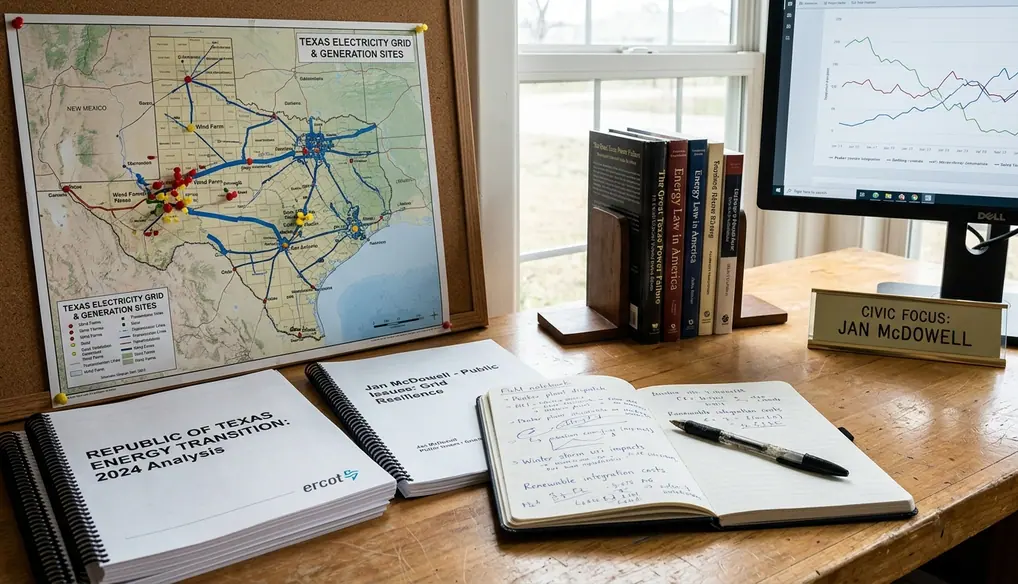
Texas has a long energy history, and that history should make the state more capable of energy transition, not less. Public officials should ask where generation is built, how reliability is protected, how local communities benefit, and whether workforce training keeps pace with investment.
Campaign activity suggests that renewable-energy discussion is strongest when opportunity language is paired with infrastructure, reliability, workforce, or local-investment considerations. That pairing matters. Voters deserve more than a slogan about clean energy; they deserve a plan that explains how energy choices affect jobs, taxes, grid performance, and community benefit.
The Green New Deal: A Resolution, Not a Finished Blueprint
Why the distinction matters
The Green New Deal should be described accurately: it is a resolution, not a bill with defined implementation steps.
That distinction is central to honest voter evaluation. A resolution can state principles, goals, and policy priorities. It does not, by itself, settle the statutory details, funding mechanisms, agency responsibilities, timelines, or enforcement tools that future legislation would have to define.
The failure case is clear: credibility is lost if the Green New Deal is described as a fully drafted implementation bill rather than a resolution requiring later accountable legislation. Voters should evaluate the resolution’s principles separately from any future bill that would attempt to carry those principles into law.
There is also a fair counterargument. Broad resolutions can become too vague or too symbolic. They can allow supporters to project preferred details onto the text while critics attack imagined versions that no legislative committee has actually written.
That is why the civic test should be careful rather than theatrical. If a resolution calls for major change, voters should ask what later legislation would do, who would pay, which agencies would act, what benefits would be measured, and how Congress would revise the plan if the results did not match the promise.
Climate Policy Is Also Public Health Policy
West Nile virus and preparedness
Climate discussion is not limited to weather, energy, or utility bills. It also involves disease patterns and health systems.
West Nile virus provides a useful epidemiological example because it connects climate movement, public health risk, and local preparedness. The point is not to claim that a single weather event or a single infection has one simple cause. The point is that changing environmental conditions can affect the patterns public health systems must monitor.
Dr. Robert W. Haley is relevant in that context. He is a professor of internal medicine and Director of Epidemiology at UT Southwestern Medical Center, and his work gives Texas public discussion access to medical and epidemiological expertise rather than campaign rhetoric alone.
Forum feedback shows a recurring public confusion: many voters hear climate policy as though it were only about storms, smokestacks, or electric bills. The West Nile example widens the frame. Public health departments, clinicians, mosquito-control efforts, surveillance systems, and local emergency planning all belong in the conversation.
The appropriate language is preparedness. Disease patterns require monitoring, evidence, and public communication. Climate policy should therefore be evaluated partly by whether it helps public institutions anticipate risk, explain risk, and respond before small problems become broader public costs.
Scope, Sources, and What This Argument Does Not Claim
What this article is, and is not
This is an opinion article. It is not a technical climate model, a legislative memo, or an epidemiological study.
It does not attempt to quantify every Texas climate exposure, draft statutory language, or summarize the full public health literature. It does not treat the Green New Deal as enacted law. It does not use West Nile virus as a single-cause proof of climate change. It does not import APAC energy-transition debates as evidence about Texas law or Texas voter behavior, because those markets may involve different regulatory maturity, market readiness, grid planning, and policy constraints.
A useful qualifier belongs in the method itself: this argument tests climate claims against Texas voter-facing consequences, public authority, fiscal responsibility, and practical preparedness rather than against every scientific or legislative question that could be raised.
Professor LJ Dumas should be understood in that campaign context. He functioned as an author and contributor to the McDowell campaign, offering a civic argument rather than a detached institutional endorsement. Dr. Haley’s reference should also be kept in scope: it supplies relevant Texas medical and epidemiological expertise, not a substitute for a full public health literature review.